
Lisbon airport
The line for Air Portugal wrapped around the entire terminal entrance, but it was okay as we had plenty of time. We had spent two days in Lisbon eating and drinking, as the this was the only European city with a direct flight to Sao Tomé.
As the line moved, we chatted about how we would keep in touch and doubled check I had everything for my trip. Before we knew it almost an hour had passed – it was 30 mins until boarding and I still had a bag check, security and immigration line to pass. Fuck. When I flagged down an attendant and told them my flight details, he frowned.
‘It takes 50 minutes to get through to your flight, which is on the furthest side of the terminal. Quickly, put your bag on the belt.’
Immediately my heart sunk, I wasn’t even going to make the first leg. I quickly turned to Sabrina and we said our speedy goodbyes, her in tears and me sad but no tears (I repress my emotions like a good kiwi lad). I then turned around and sprinted off, cutting through every line and queue, ignoring the tssks and complaints of other passengers. I ran to immigration, sweating heavily, got through and then sprinted to my gate which really was the furthest away it could have been. I was a panting, hot mess.
We of course boarded an half an hour after that.
The host for my first stop had messaged me to book my seat on the right hand side of the plane, so that I could see the whales breaching and the islands as I landed. So, I splashed out on an exit row, which as I soon realised, had no window, and was the only spot on the plane without one. I plugged my headphones in and watched the in-flight TV instead, quietly jealous of the passengers in front of me pointing excitedly out the window when we landed 7 hours later.
As I got off the plane into the muggy tropical heat I had a massive smile on my face, it was the start of a new adventure. The humble airport consisted of 4 immigration officers and a single baggage belt – expected for what is apparently the 4th least visted nation in the world. As I sat waiting in the line, two things were running through my mind:
1. I had dropped the bag off under an hour before the flight took off. Would it even have made it?
2. Would my visa actually work?
I did have an ‘online visa’, for which I had to jump though hoops of bureaucracy and outdated online systems (If anyone reading this needs help, this guide is quite good or feel free to email me!) – but I was only half convinced it would actually be accepted. Along with this I was meant to have 100 euros cash for every day I was there (queue Sabrina and I running around Lisbon to take out cash at 200 euros a pop) as well as paid in full ‘hotel’ bookings. I wasn’t staying at a hotel and I hadn’t paid. The line was slow in the humid airport where long broken air conditioning machines teased you with their presence, just for decoration. Like most reasonable people I have an aversion to lines, airports and bureaucracy – but I find that the other travellers often annoy me the most. As we shuffled along in the heat I couldn’t help but notice that every time an officer became free, they had to call the next person in line at least a few times to come forward, as that person would inevitably be looking at their phone, the ceiling or literally anything else. Small things like this often annoy me, but I knew I would have to chill out – this was going to be the least of my worries if I was going to get through the many border checkpoints this trip presented.
I walked right up to the officer (he didn’t have to call me!) – and he asked me to present a list of items. Visa? Check. Yellow fever vaccine? Check. Hotel? He didn’t know it and had never heard of it, but I smiled nervously hoping I wouldn’t have to splash out for one of the expensive resorts on the island. He called a police officer over who took me into another room…great, I thought. I smiled nervously as the officer looked through my passport and checked my visa.
‘Nouvelle-Zealandia…’he looked at me strangely, then mouthed out the sounds ‘Aoo-tee-aaaaa-rooaa’ (its written under New Zealand on the Kiwi passport), then shrugged, stamped my passport and I was in. Even better, my bag was spinning slowly round the conveyer belt, waiting to be slung on my shoulder – made it!
Outside, I took the taxi of the first man who locked eyes with me (often not the best tactic at any airport without a queueing system), but I was happy to be fleeced on my first trip. We agreed on a price of 20 euros, and off we went. To my surprise, he had a full TV is his beat up Suzuki Jimni, and asked if I liked music. He proceeded to blast afrobeats, music videos and all, while he kept one hand on the wheel and spoke loudly into his phone. As we zipped round the dark streets, he explained to me that his wife was landing from Gabon that evening and he was late to pick her up (he must have left her for me as that flight arrived 30 mins later). Her irate screaming was audible above the music, and I couldn’t help but laugh as the driver smiled and winked at me.
20 mins later we arrived in a pitch back neighbourhood, and bumped down a dirt road, coming to a stop in the darkness. My host Jack had informed me over WhatsApp that there was no power in his suburb (we had passed some areas with power, but not here). Jack lived in the middle of an area called ….. which, to say the least, is not a usual tourist haunt. I would come to learn that the government had a habit of not paying their electric bill, and so their foreign energy provider would often withhold electricity from the island and the government would selectively turn off the power to the more deprived neighbourhoods (including this one).
Getting out of the car into the darkness, I panned around for the red gate I was told to look out for (there are no numbers on the houses here) and came up short. My driver sped off down the road leaving me with my torchlight and two stray dogs for company. I felt a tap on my shoulder and turned around to see a teenage boy. Slightly startled, I said ‘hey’ and he rattled off a few sentences in Portuguese before shouting ‘Jackiiiii’
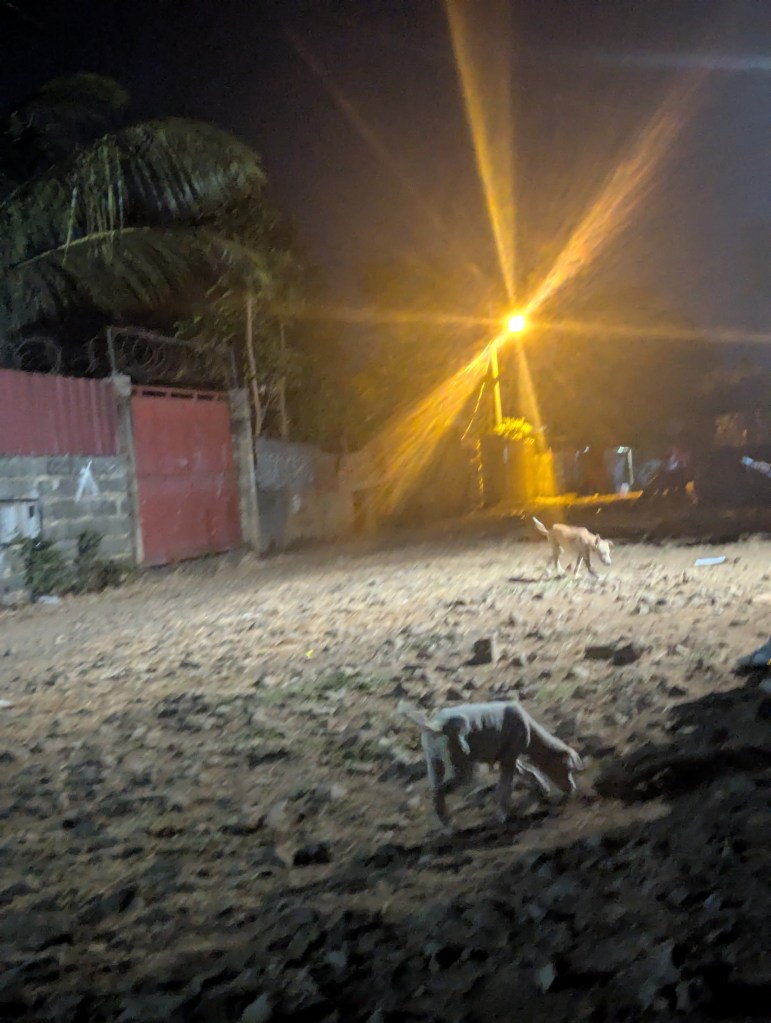
A few seconds later, I hard a loud clank and a white guy who looked about in his 50s appeared out of the darkness, cigarette in his mouth. He introduced himself as Jack in a thick welsh accent. I had chosen this place as it was literally the cheapest I could find on booking.com, plus he had a chill bio. After we settled in, I eagerly accepted a cold beer he had waiting for me, and he asked if I wanted to get my admin out of the way.
There are usually two things you need to do when arriving in an African country: get a sim card and withdraw / exchange your cash. Cash is king here, you won’t be able to pay for anything with a card outside of maybe a high end resort bill. Jack helpfully was going to take me to do both on the back of his motorbike, so a few kicks of the engine later we were off down dark bumpy roads. As we rode, Jack told me about some of the quirks of island life; getting supplies, the local cultural nuances, etc etc. I noticed we had passed two one legged people already, limping along on crutches, and I asked jack if there was an issue with infection/ gangrene.
‘No, it’s actually the motorbikes. The hospital here cant reconstruct legs after a bad crash…’Their loud bikes wizzed by and overtook us by inches. ‘…and the people here’, Jack continued, ‘can’t afford to fly to Lisbon, so they just cut them off. Oh, and there are no drunk driving laws on this island so that doesn’t help. Always assume everyone is drunk when driving around.’
This was great to hear as we wizzed down dark gravel, pothole-ridden roads on an ancient motorbike, on a Saturday evening, me with shorts and no helmet, thinking back to that beer me and jack had shared and the other few bottles open bottles sitting around. I would come to learn that driving was a whole other experience on the island…
Getting the sim was straightforward, but exchanging cash was a little more exhilarating, as Jack told me that the banks ripped you off so we were going to go to the street changers instead. We pulled up next to a row of men, each with a large satchel slung over his shoulder, sitting on small stools one street behind the main thoroughfare. The biggest of them stood up and smiled at jack, they shook hands, and Jack explained that I wanted my Euros changed to Dobras. I fumbled nervously getting the cash out of my pocket, in one pocket I had 100 euros ready to change, but in the other I had what would be more than a year’s salary here. The man took my cash and pulled out bundles of old notes, opening the calculator app on his phone he put in 100 x 26 – then made sure I gave a thumbs up for the 2600 figure. He then urged me to count the money, which took some time in the dark street with me dropping a few notes in the process. Its wasn’t the smoothest transaction but we got there in the end!
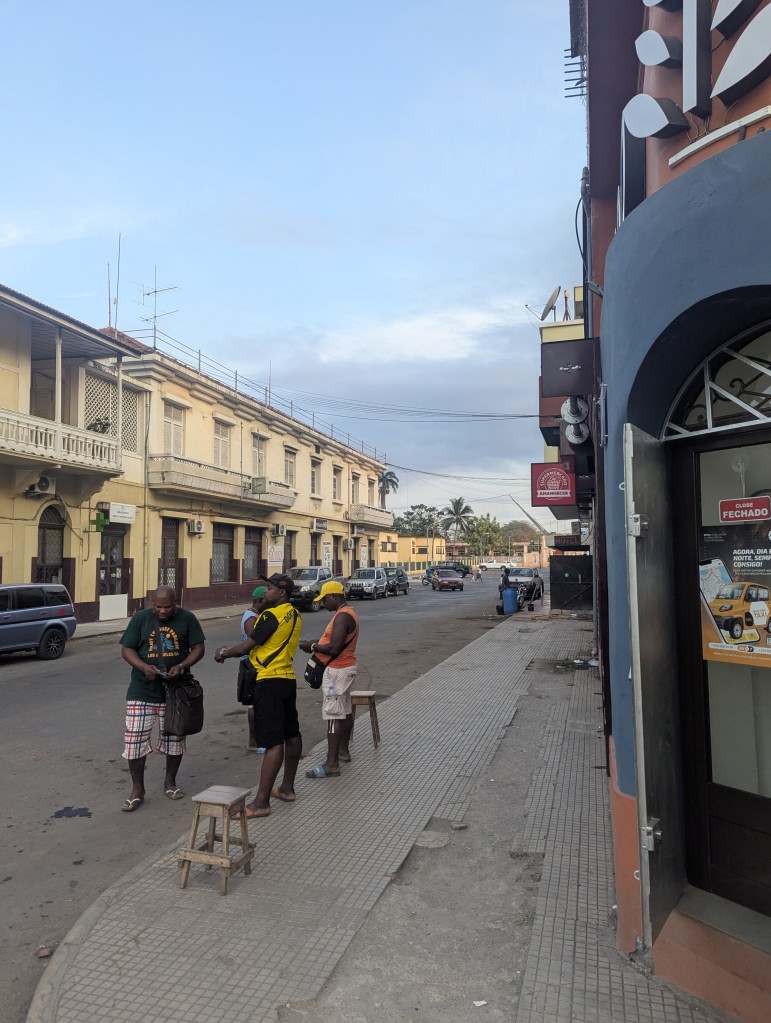
Money changers – (photo taken during the day)
We hopped back on the bike and went up the hill to Jack’s friend’s restaurant. Jack’s friend was a huge Sao Toméan man named Teo , an ex-MMA fighter who had apparently trained in America, but hadn’t made it and was now back home. Jack had a special arrangement with Teo where he would loan him the money to get the food and drinks for his rolotti (restaurant) on a monday and he would be paid back the following week, this way he was able to stat his business. We got one whole chicken to share. Jack explained there were two types of chickens on the island, regular ones and island ones. The one we were having was the latter, a skinny lanky thing, kind of like Chicken Joe from the movie Surfs Up, if you’ve seen it. Someone had placed a plastic cup over a phone torch to use as our lamp and we ate our chicken in the darkness while Jack clued me in on the ins-and-outs of island life. I was half listening, but just happy to be there, as I had made it back to Africa after more than and decade. Adventure awaited…
—
The city
The next morning at 6am I woke to an oddly paced tapping on my window.
Tap, tap tappp, the sound of fluttering tap…….taptaptaptaptaptap.
I figured there must be some kind of big insect caught between the curtain and the window pane, so I rolled out of bed and cautiously pulled back the curtain, expecting a cockroach or something worse to fly into my face. To my surprise, I saw a tiny, tiny bird outside my window having a fight with its own reflection (or maybe flirting with itself, I couldn’t tell). When it saw me it quickly darted away, but it would come back often to fight its own reflection, and that became my defecto alarm from then on. I learned later that it was a São Tomé prinia.
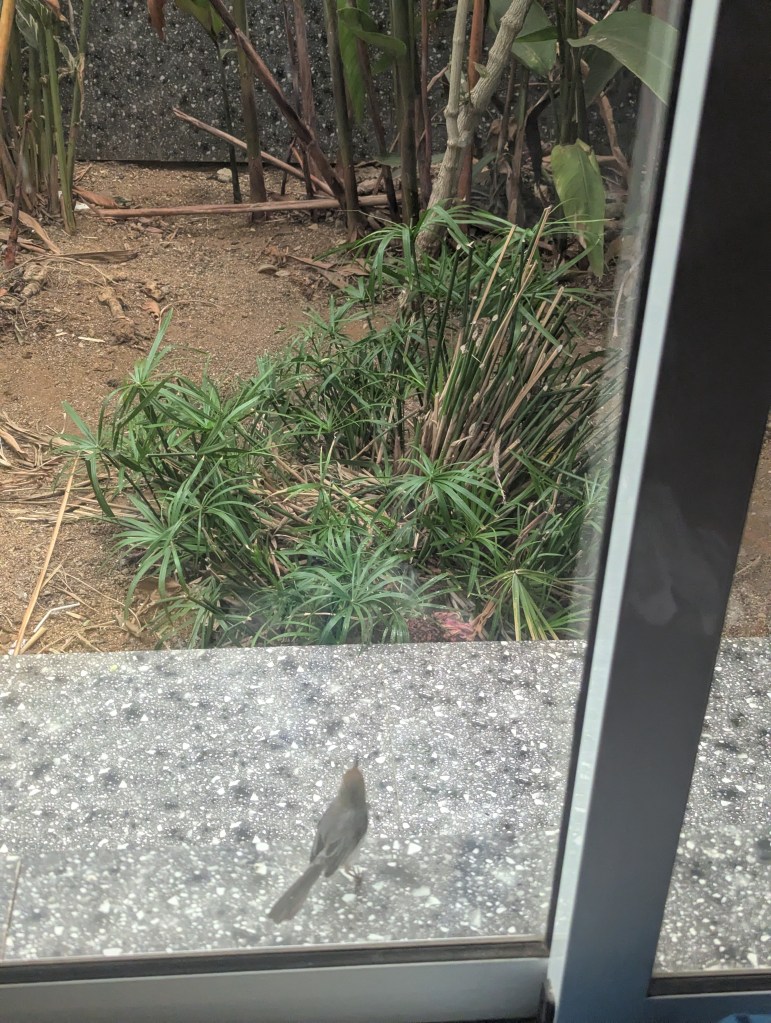
I figured there must be some kind of big insect caught between the curtain and the window pane, so I rolled out of bed and cautiously pulled back the curtain, expecting a cockroach or something worse to fly into my face. To my surprise, I saw a tiny, tiny bird outside my window having a fight with its own reflection (or maybe flirting with itself, I couldn’t tell). When it saw me it quickly darted away, but it would come back often to fight its own reflection, and that became my defecto alarm from then on. I learned later that it was a São Tomé prinia.
I decided carpe diem was the best course of action and the first thing I wanted to do was go for a run. I wanted to at least run or hike every day, as I had been noticing that I didn’t really fit as well into my old pants after 3 years of London pubs, and my vanity could not take it. As well as refreshing my mind this trip would hopefully get me in shape again.
By the time I left, the tropical heat was setting in – warm and humid, the island averages around 30 degrees celsius in September. Jack’s street looked a lot different during the daytime. It was quite an underdeveloped part of town, with a craggy dirt road, chickens and stray dogs lounging, and a rusted out car that had been laid to rest right in the middle of it. Two doors down there was a shop of sorts, the type which you find in may African villages, just an open-door with metal bars where you ask for what you want and they pass it through. Further down the road, there was a bakery with a huge clay oven (charcoal powered), which made bread every morning in small rolls. Jack introduced me to the residents on this particular street and everyone was kind and welcoming, laughing at Jack’s jokes in broken Portuguese.
I jogged down the hill towards the centre of the capital. The original plan for my trip was to start in Morocco, through Mauritania, then hop along all the subsaharan countries until Gabon. That was until Haydn, a friend of mine, asked if I had checked the temperatures in the desert, and wondered how I would fare hitchhiking in the heat? I soon realised it was a foolish endeavour I looked for other places to start. Sao Tomé only came up as I was trawling online forums for information on how to get my visa for Gabon (a long and tedious process I still haven’t managed to crack as I write this, fingers crossed) when I read a comment saying, I got my visa at the embassy in Sao Tomé!’’ Never having heard of it, I looked it up and was immediately intrigued.
São Tomé and Príncipe, two volcanic islands in the Gulf of Guinea, were uninhabited until their late 15th-century discovery by the Portuguese. They became a Portuguese colony and a slave trade hub, with their rich soil and tropical climate ideal for sugar, cocoa, and coffee plantations, leading to the exploitation of African slave and contract labor.
São Tomé is larger and mountainous, with Pico de São Tomé over 2,000 meters; Principe is smaller (relative to the already small Sao tome!) with over a third of its area being a national park. Both feature lush rainforests, diverse ecosystems, and many rivers, with average September temperatures around 30°C.
The islands are home to unique endemic, flora and fauna, including towering trees, ferns, orchids, and a variety of birds (like the São Tomé prinia), monkeys, reptiles, and insects. The surrounding waters with which the local people reply on for much of their food are rich in marine life from sailfish to turtles, whales and dolphins.
In my mind, it was the ideal place to start my trip; somewhere off the beaten track, but with what seemed like a chill island environment where I could settle in before the mainland. As I ran through the capital, it was not too different from old colonial era towns I had seen in Mozambique. Churches dominated the main squares, with old decaying colonial buildings now empty and mostly being used as warehouses. Open air markets are everywhere, selling clothes, kitchenware, suitcases full of pharmaceutical drugs, open air barbecues, banna and fried dough, ice blocks and more. Most people get their everyday needs from these markets, whereas tourists go to restaurants and supermarkets.
As I ran up the coast, the beaches were full of mothers doing their laundry in the surf and children playing around them. It was nice until the sole of my shoe caught on a piece of metal and the back ripped almost clean off. Day one, shoes are done.
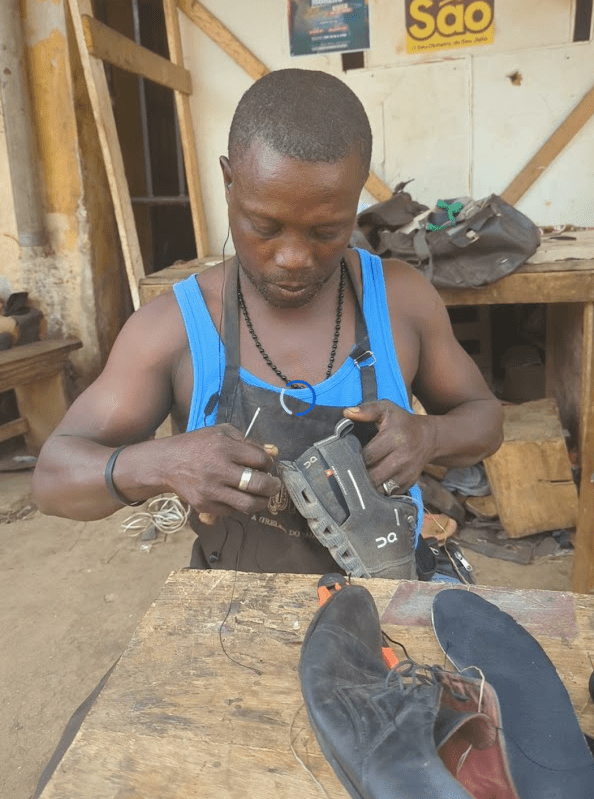
After a quick swim in the harbour, I wandered back through the market and I noticed a guy who seemed to be a cobbler of sorts. I caught his eye and pointed to my shoes, and he repaired it by sewing the ribber in the sole to the base with a needle and thread. I got him to do the other for good measure. 5 minutes and 2 euros later, I was sorted for the rest of the trip (I hope).
Hungry by now, I searched the town centre for a for restaurant. It’s not bigger than a few blocks, and not the place you would stick for more than a day but it was interesting enough. Something that’s hard to miss on Sao Tomé are the dogs as they are everywhere. Miserable little strays, each exactly alike, a light tan or brown colour, all carrying various ailments (a broken leg, battle scars, bites etc). They dart in and out of traffic looking for scraps and lie in the shade panting in the tropical heat. They are also despised on the island, generally picked on by everyone, including other strays. Kids throw rocks at them, adults kick them out of the way, and they get into big bust ups with each other in the middle of the night. It kind of begs the question of why they are even here. A quick nurturing programme would sort the issue out in a number of years. It’s hard not to feel sorry for the poor things… at a distance.
I settled on a restaurant on the roof of one of the old colonial buildings, the kind of place tourists (like me I’m not counting myself out!) would go. I ordered a fish and banana chips, with a bottle of the local brew ‘National’. I had brought a few books with me, and at this point started to read Charles Dickens’ self-written biography about his youth, which along with my sister Virginia, inspired me to write this blog! If you get a chance it’s a great read, and the nonchalance with with he describes his insane life pre, during and post ww2 is quite funny, which combined with his obviously great writing makes for a good read. The cool beer and the heat were a good combination, as I stared out towards the steam rising off the rainforest where I would be hiking tomorrow. I was looking forward to being in the jungle again, hoping this trip would be what I had built it up to be in my mind – something a bit dangerous, a bit fun, and very interesting.
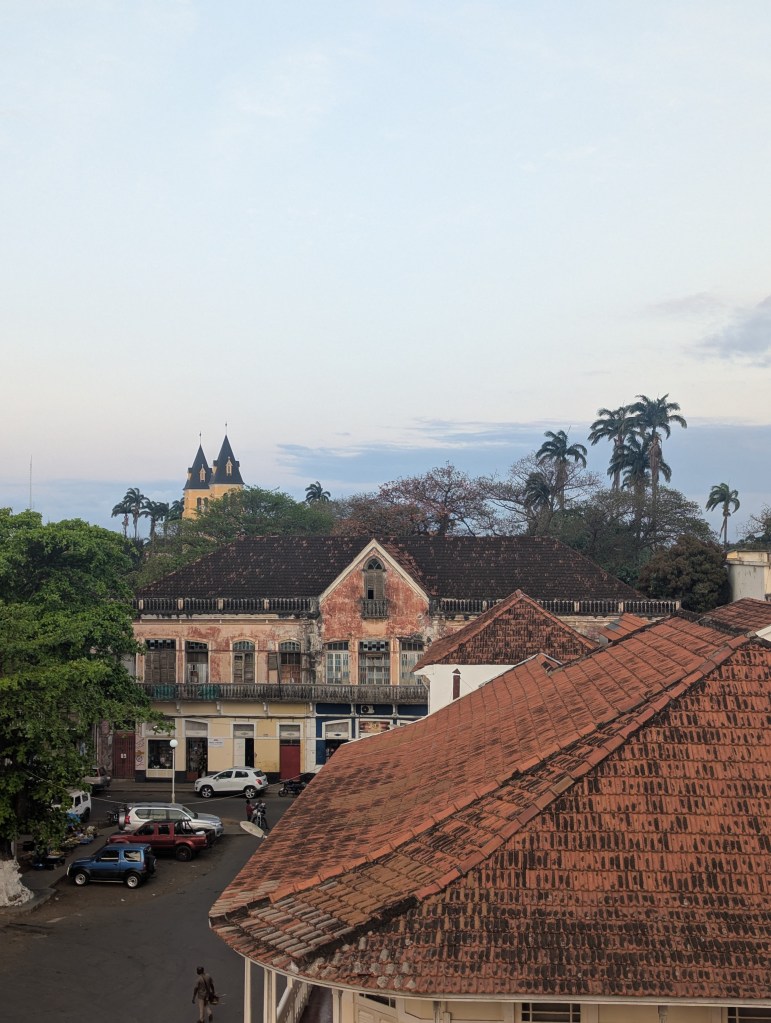
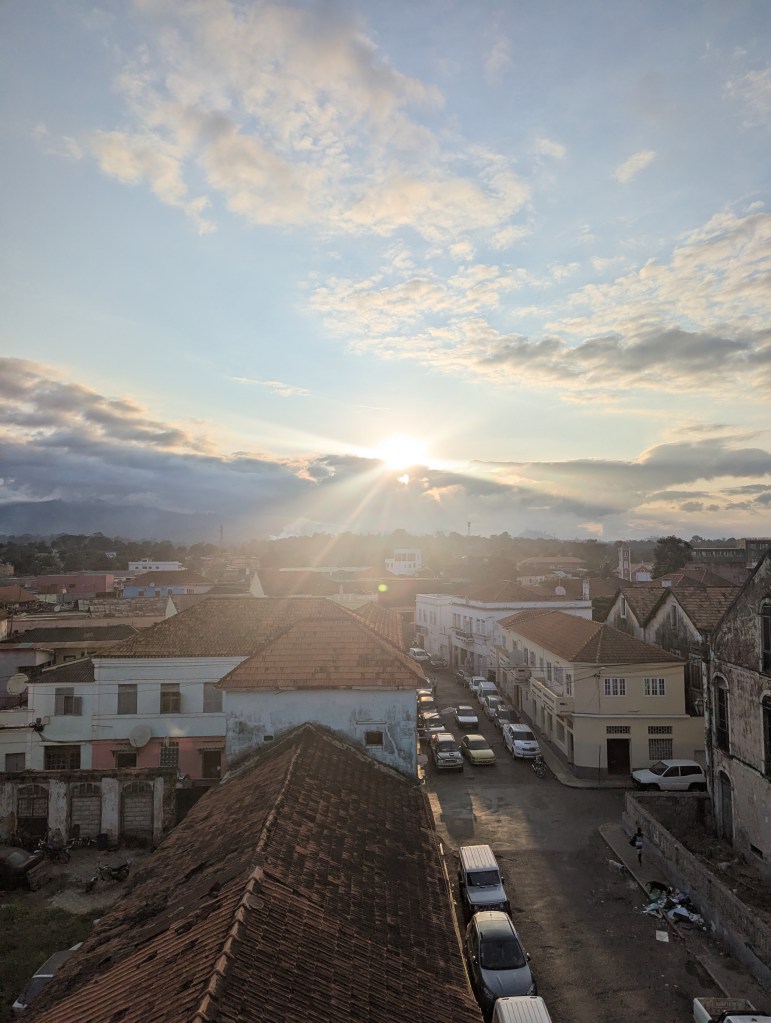
Rooftop views
Then jarringly, a familiar twang sounded out at the table behind me:
‘Hey mate, could we grab two more beers? Cheers mate, legend.’
Aussies – just like east London, you can’t escape them anywhere. I took a risky bike back to bed.
 Falling Down Africa
Leave a comment